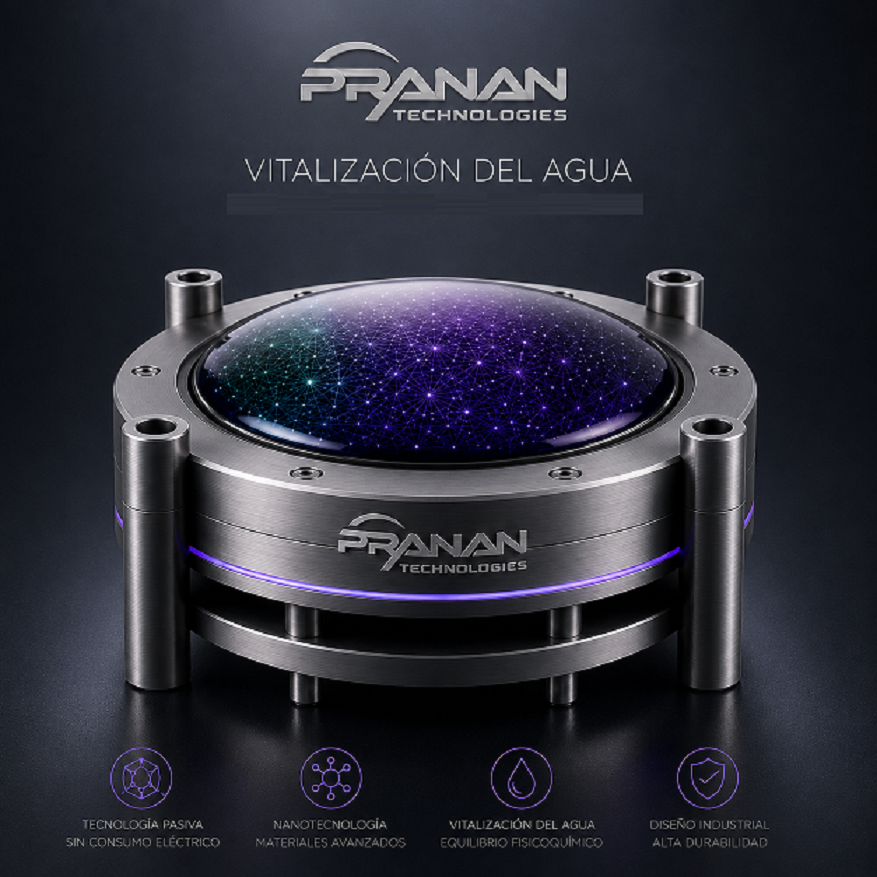
A joint research program conducted by Pranan Technologies and the Department of Applied Physics at the Universitat Politècnica de Catalunya (UPC) has demonstrated measurable and reproducible changes in the physicochemical properties of water using a completely passive technology. The study also establishes an objective methodology for the scientific evaluation of the phenomenon known as water vitalization.
The study’s most significant contribution lies not only in its experimental findings but also in the scientific definition of the concept of water vitalization itself, based exclusively on quantifiable physical parameters measured using calibrated instrumentation. Within this framework, water vitalization is defined as the stable and reproducible modification of specific physicochemical properties associated with enhanced equilibrium and stability of the aqueous system.
To test this hypothesis, the research team analyzed samples of commercially available bottled water before and after exposure to the device developed by Pranan Technologies, evaluating two of the parameters most commonly used in water characterization: pH and electrical conductivity.
The results revealed significant differences compared with the control samples. In some experiments, pH increased by as much as 3.45%, while electrical conductivity increased by up to 14.44%. According to the researchers, the reproducibility of these results across multiple experiments and different experimental configurations provides evidence consistent with a measurable physicochemical reorganization of water.
One of the study’s most innovative aspects is the nature of the technology itself. Unlike conventional water treatment systems, the device operates entirely passively: it requires no electricity, batteries, or active electronic components, and introduces no chemical substances into the water. The observed modifications arise exclusively through the interaction between the water and the advanced physical architecture developed by Pranan Technologies.
The scientific direction of the project was led by Dr. Fidel Franco González, physicist and researcher in the Department of Applied Physics at UPC. The investigation also showed that the successive evolution of the prototypes developed throughout the R&D program was associated with progressively stronger experimental effects, with the most advanced device configurations producing the highest responses.
The authors believe that this work provides a solid experimental foundation for future research while establishing an objective methodology for investigating water vitalization through measurable, reproducible, and comparable physical parameters. At a time when energy-efficient and non-invasive technologies are attracting increasing scientific and industrial interest, this research places the collaboration between Pranan Technologies and the Universitat Politècnica de Catalunya at the forefront of research into passive technologies for water treatment.